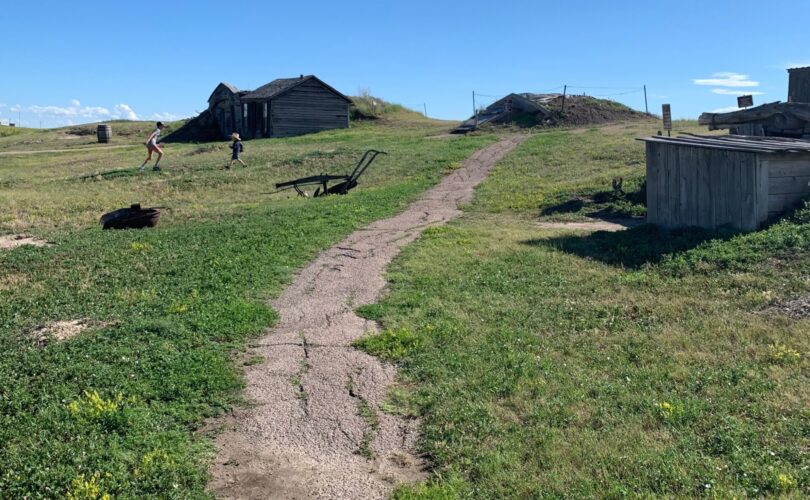
I had read about the original homesteads settled under the Homestead Act of 1862, but I never expected to visit one in person. So when we saw the signs for the Prairie Homestead Historic Site a few years ago while driving through South Dakota, we decided to stop. I’m glad we did. It’s an original, intact collection of buildings and equipment still sitting on an original homestead farm, in one of the areas settled in the early 1900’s.
As we walked up the hill to the old buildings, the kids were fascinated by the prairie dog town. We don’t have those in Alabama, and my boys were sorely tempted to try to catch one. I don’t think they could have even if I’d let them. The prairie dogs dove into their holes and popped up somewhere else from another tunnel entrance before you could blink. I can see why riders on horseback avoided crossing a prairie dog town—it’s asking for a tumble and a broken leg.
The buildings were well preserved by the dry Dakota climate. The house was a true dugout, built back into the hill for protection from the harsh weather and long winters. Behind the barn, the old farm equipment was still parked where it had been left.
As we drove on through the area, you could see the remnants of old dugouts everywhere. The reason? Most of the homesteaders who tried to claim 160 acres of free land by settling and farming it for five years didn’t make it.
Why so many failed
Unlike regions of the country settled by farmers who weighed market demand, location, and available resources like water and soil, much of the western settlement was driven by government policy—an attempt to create unnaturally favorable conditions to attract farmers.
In New England and the Midwest, agricultural settlement was more organic. Towns and farms grew up in the places most likely to succeed over the long term, and the result has been stable, productive, multi-generational farming communities.
The farmers who settled homestead land were drawn by the lure of free land. But free is often the most expensive thing to base a decision on. The result was a landscape known for ghost towns, abandoned farms, and dust bowls from plowed-up ground that should have stayed in grass and cattle, as it was before the Homestead Act.
Does government favor actually help farmers?
When we see the government trying to help farmers today, the same pattern shows up: help through favor. Subsidies, grants, cheap loans, and free farm education all seem like good ideas. Yet instead of a thriving farm population, we find ourselves with more bankrupt farms, high rates of farmer suicide, a fragile food system, and fewer family farms.
So, does government favor actually help farmers?
I don’t think so. That’s one reason I haven’t taken advantage of the many grants available to small farmers. I’m wary of the risks of dependency. I’m concerned about decisions driven by short-term free money instead of long-term profitability. And I want to guard against my own tendency to shift my trust from God to the government.
Rather than helping farmers by showing them “favor” through unnatural economic conditions or handouts, I believe God’s intention is for government to provide an environment of freedom—where farmers can make good decisions based on real market conditions and compete on an even playing field with every other producer.
In Romans 13 we see that civil government is to “commend” those who do right and also to “bring punishment on the wrongdoer.” You aren’t free to farm if anyone can lie, steal, and kill with no consequences. That’s what makes it so hard to succeed as a farmer in parts of Africa where government has collapsed and warlords rule.
The challenge for American farmers is the opposite: being weakened by help. Since government produces nothing itself, the only way it can show favor to farmers is by giving them what has been taken from other productive people in the community, through taxation or inflation.
Welfare may be well intentioned, but in reality it is forced redistribution of wealth. It doesn’t add to the real welfare of a nation. It deadens the creativity that tough conditions spur, while oppressive regulations punish the innovative solutions that do emerge.
George Henderson, a British farmer chafing under wartime agricultural regulations that were meant to help farmers, put it memorably in his 1950 book Farmer’s Progress.
“Countries are well cultivated, not as they are fertile, but as they are free . . . To invoke Government assistance is like tying a brick to a cow’s tail when she has flicked you in the face. The next time she swings her tail you will be hit on the head with the brick.”
If we are to truly succeed as homesteaders and farmers, we must trust in God alone and learn to work within His established laws and principles—of finance, economics, creation design, and proper family, church, and civil authority.
Living as free farmers
No society or government will ever be perfect, of course. As Christians we look forward to the coming of the only perfect government, the Kingdom of Christ. But in the meantime we are His ambassadors, bringing His will to earth as it is in heaven, showing others how to live for Jesus and extending His offer of salvation.
How do we do that? I have plenty of ways I need to do this better myself. I would love to hear what ideas you have. But here are a few thoughts I have on where to start.
First, learn to live free in the way only a follower of Jesus can. We are free to live for Jesus no matter our earthly situation, whether we’re independent homesteaders raising a family or persecuted church members in solitary confinement. This freedom is a freedom of the heart. Freedom from sin. Freedom from dependency on faulty people, faulty governments, and our own sinful hearts. The freedom to obey the commands of Jesus and do what is right.
Second, express that freedom by taking personal responsibility. Work hard. Provide for your own needs and the needs of others in your community. That’s what self-government is. Grow your own food. Serve with your local volunteer fire department. Help your neighbors. And train others so they can be free by providing for their own needs.
Third, prayerfully reconsider our cultural habit of using debt and grants to speed our way through life. Lack of money and resources is one of the loudest ways God directs our lives. It’s like a fence—one we can climb over, but one that’s often put there on purpose, to teach us what we need to learn now, before we’re given greater responsibilities.
God is a good Father. Do we really think His normal plan requires us to enslave ourselves to a lender or the government in order to obey what He’s calling us to? Scripture calls debt and worldly dependency a curse, not a blessing—something to avoid when we can, not to seek for the power it promises.
Let’s be free farmers. Free from dependency on anything except God and the means of provision He has established: our hands, the land, family and community relationships, the church, the Scriptures, and the Holy Spirit. It may be costly. But the reward is homesteads and families that last, instead of blowing away with the false promise of easy solutions and free money.
Sadly, the Prairie Homestead Historic Site is now closed. But I would much rather visit your vibrant, living homestead than the remnants of one long abandoned. And you’re welcome to come visit ours as well.
Brilliant insights and perspectives, Noah!
At a Small Business Administration talk, the presenter said the main reason businesses fail is for lack of money (i.e., trying to push loans). Saying that is like saying the main cause of death is lack of heartbeat and breathing – there are much deeper issues and dynamics at play.
As Wendell Berry went Home two days ago, I’m realizing time for each of us is limited. May we each fulfill our respective callings in each day we’re given.
Geoff,
So true. In a book I have called, “War on the Poor”, he makes the observation that poverty is a symptom that can help motivate a change of management in your resources. Remove that and you remove the indicators that change is needed. That is why just giving resources to people doesn’t fix the problem. You have to teach faithfulness.
Yes, the days are short. Seeing people like Wendell Berry go home with the Lord definitely makes it real. Let’s be humble and faithful. And redeem the dirt until Jesus comes! Then we can really have fun farming.
Thank you Noah for your insights into true freedom, the freedom we find in Jesus.
Amen. Thanks Joe!
So true Noah! You are speaking truth! Look at New Zealand, they ended all government subsidies and they came back strong. I’m with the government and I’m here to help you! We run our homestead without debt and Yahuah has blessed us so much.
Ted, I had forgotten about New Zealand. I remember hearing about that and need so look into it again. Glad to hear about the testimony of your homestead.
Spot on Noah! May the Lord Jesus always have preeminence in all we think and do. God’s ways are not our ways.
Amen Steve!